Automotive / Manufacturing

How We Uncovered an Untapped Organic Growth Asset Across Continental Tyres UK's Retail Network

Client Continental Tyres UK
Industry Automotive / Manufacturing
Engagement Technical SEO, product visibility & network-wide digital infrastructure audit
Focus areas
Organic visibility Product discoverability Local search Scalable infrastructure Network performance
100+ Independent retailer websites in the network
4 Websites audited to model the entire network
1 Platform-level fix, network-wide impact

The Situation

Continental Tyres was investing in a growing network of 100+ independent retail websites across the UK, managed through a national retail distribution partner. The network gave independent garages a digital presence in their local markets while representing Continental products at a local level, connecting a national manufacturer with customers actively searching for tyres in their area.

Laurence George, Marketing Manager at Continental, contacted us to advise on the national distributor's website network. From our first assessment, one challenge became clear: volume. With 100+ websites, the question was: how do you assess and improve a network of 100+ websites without having to assess and fix 100+ websites individually?

We looked carefully at the infrastructure behind the estate and found that, although the websites served different retailers and local markets, they shared the same underlying platform, backend technology and, in many cases, frontend templates. That meant an issue identified on one website could potentially be repeated across the network, while a solution at platform level could create value across 100+ sites.

Rather than recommending a resource-heavy site-by-site audit, we proposed a strategically selected sample of four websites, chosen for their relevance to Continental and their ability to provide meaningful insight into the wider network. This let us investigate the platform in depth while keeping the initial assessment focused and cost-efficient. It gave us the evidence needed to understand a network of 100+, identify where the greatest commercial opportunities existed, what could be solved at platform level, and what needed a more targeted approach. What we provided was a scalable roadmap for improving organic visibility, product discovery and local search performance across the wider network.

Before working with ilumi on this project, we knew very little about our partners' websites were working and performing. There was restricted data to go on, so before investing into our brand's presence I wanted to understand what was achievable with the current site setup. Providing added value support to our partners is an important part of our co-marketing approach, so we needed technical expertise combined with strategic forward thinking. While we were looking for an agency to partner with, ilumi stood out: their technical, no-nonsense knowledge was clear to see, and they were able to communicate even the most complex digital areas in simple, easy to understand language with examples. The fact that they did everything in-house with specialists gave us the confidence that we would be in the hands of experts who could turn around requests quickly.
Laurence George Customer Marketing Manager, Continental Tyres UK

The Commercial Problem We Identified

Because the audit framework we designed focused on business impact as well as website and platform performance, the biggest commercial issue we uncovered was that Continental had 100+ local websites representing and selling its tyres across the UK, but the network was not capturing the search demand those products could have been appearing for.

This is a good example of how it looked in reality: a retailer in Reading has a full range of Continental tyres available to its customers and hundreds of Continental product pages on its website. Yet when a customer in Reading searches Google for a specific tyre such as the Continental AllSeasonContact 2, or an OE (Original Equipment) tyre for a particular vehicle, those relevant product pages don't surface in the results at all.

That meant Continental was missing some of the most important product searches. At the same time, because these product pages weren't visible to Google, the retailers' websites were also being deprioritised for the most competitive, high-volume tyre queries in the industry, such as "buy tyres" and "tyres near me". Google simply wasn't seeing these sites as sufficiently relevant to surface on the results page.

We set out to understand what was preventing those products from surfacing, why it was happening, and what could be changed at platform level to unlock that visibility across the wider estate. What we found revealed the potential to turn the existing network of retailer websites and product pages into a significant organic search asset for Continental, using infrastructure that was already in place but not yet fully utilised.

ilumi not only grasped the brief given, but they evolved it into something much more beneficial for both us and our customer. They were going to save us time and cost by reducing the audit to four focused sites, while still giving us the wider picture of how the web network was performing as a whole. They identified very serious blockers straight away to our brand and product visibility from an SEO point of view, but opened our eyes to the huge potential that lay ahead.

Laurence George Customer Marketing Manager, Continental Tyres UK
Continental Tyres retail network visibility overview
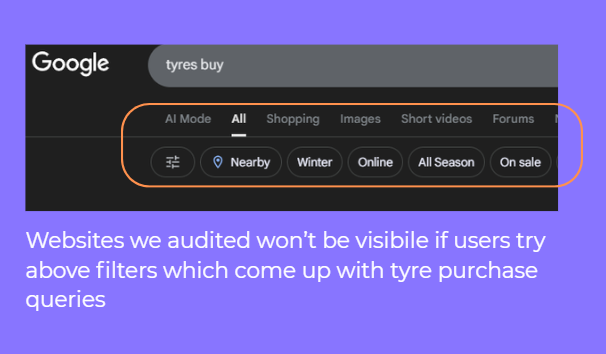
Audit finding: the websites were not eligible for tyre industry relevant search filters

What It Took to Find It

We combined our proprietary crawling technology with technical SEO, search, competitor and local analysis to investigate the four websites and the national distributor's platform.

1

Crawl

Crawled the selected websites and platform in depth, looking at technical metrics, server, infrastructure, local search and local competitors.

2

Analyse

Compared findings across the sites to identify what was unique to a retailer versus what was being caused by the shared platform.

3

Compare

Looked at competitors and actual search results to understand where Continental was missing visibility, and what customers were seeing instead.

4

Identify

Connected the commercial problem to its technical causes: product pages that couldn't compete in search, indexation gaps and platform limitations.

5

Prioritise

Assessed opportunities by commercial value, scalability and complexity, focusing on changes that could matter across the wider network.

6

Turn findings into action

Translated findings into practical solutions, identifying which changes could be made at platform level and scaled across 100+ websites.

The four-site investigation gave us the evidence to understand the wider network and, more importantly, showed us where the biggest opportunities were.

What Exactly We Found & What Was Causing It

The biggest commercial problem - Continental's products not appearing for relevant searches - came down to several connected issues across the platform and websites.

01

Products existed, but Google couldn't properly discover them

Retailer websites contained hundreds of Continental product pages, but the main tyre-finding experience relied on a dynamic vehicle registration lookup tool. The underlying products were therefore not being exposed to search engines as crawlable webpages.

A customer could find the tyre on the website, but Google could not always find the tyre on the website. This meant Continental products were missing opportunities to appear for high-intent searches such as "Continental AllSeasonContact 2 Reading", "tyres near me" or specific OE tyre searches.

Our solution

We designed a scalable product-page solution that could work across the existing platform. Our aim was simple: fix it once, scale it across the network. Rather than creating and maintaining hundreds of individual fixes, the solution could generate the required product infrastructure across the relevant websites, keeping workload and cost from growing with every additional retailer or product. Pages were also localised and optimised around relevant product, vehicle and location searches - search infrastructure designed to keep working across the network as it grows, not a short-term SEO campaign.

02

Valuable pages were not consistently indexed

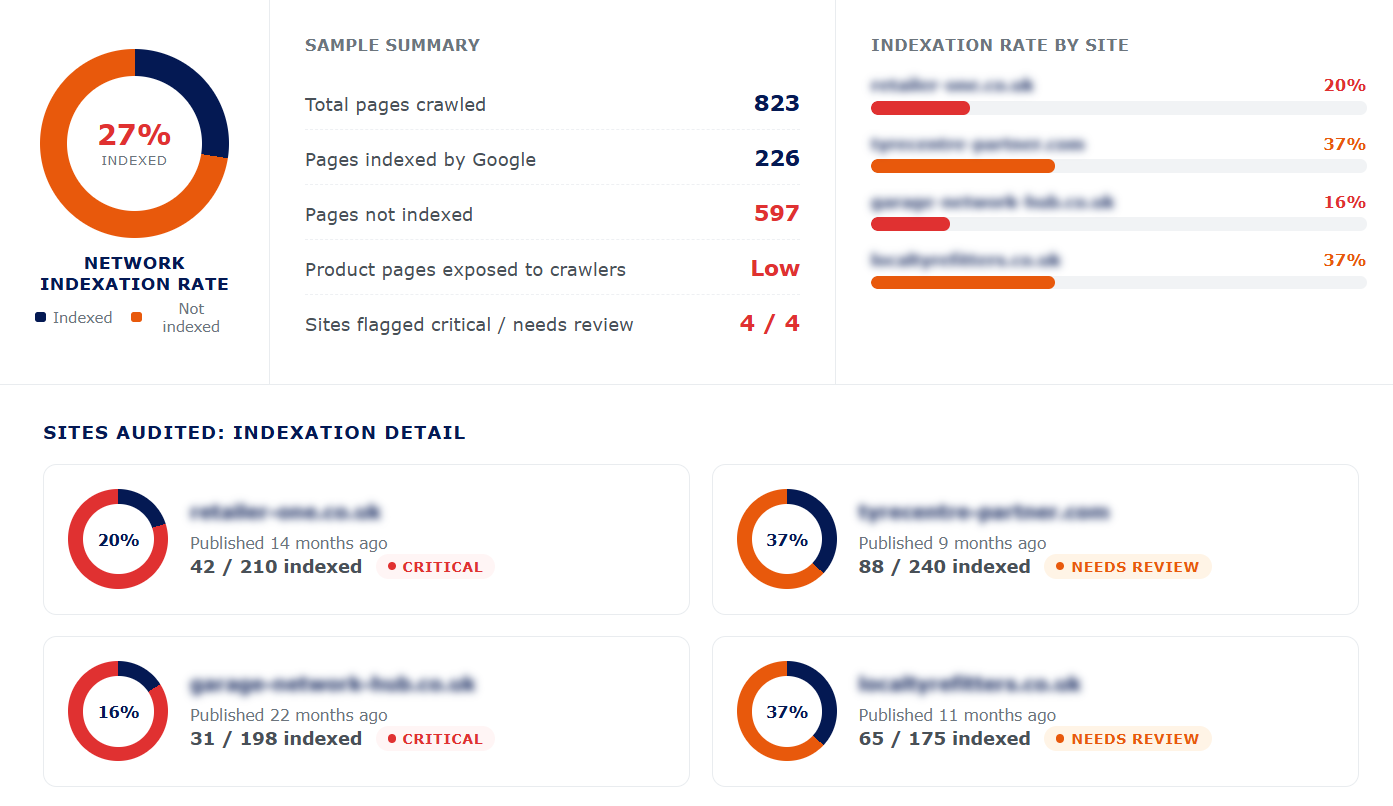
Our analysis found hundreds of live web pages that were not available on Google at all. With new websites and pages being released regularly across the network, there was no consistent process for checking indexation or submitting new URLs for discovery. This was creating a growing backlog of pages that were live but effectively invisible in Google.

For local garages, that meant less opportunity to be found. For Continental, it meant less visibility for the products represented across the network.

Our solution

Manually managing indexation across 100+ websites and potentially thousands of pages would be resource-heavy, so we designed a solution that connects directly to the national distributor's platform and automatically triggers indexation processes when new or updated pages go live - a more reliable, scalable way to get valuable pages into Google and keep the network visible as it continues to grow.

03

One platform issue was affecting 100+ websites

Because the websites shared the same underlying technology, our framework identified technical issues that were not isolated to individual retailers - they were being created at platform level. That meant the same problem could be affecting 100+ websites simultaneously.

Our solution

Instead of requiring Continental and the national distributor to repeatedly diagnose and fix the same issue across individual sites, we traced the problem back to the shared infrastructure - one infrastructure fix could remove the same issue across the wider network. Rather than creating 100 separate SEO fixes, we identified where the underlying platform needed to change, reducing duplicated work, cost and ongoing maintenance across the estate.

04

Local search potential was not being fully utilised

With Google becoming increasingly focused on relevant, trustworthy and locally useful results, consistent local information matters - particularly for businesses competing for searches such as "tyres near me". Across 100+ independent retailers, manually checking Google Business Profiles, opening hours, contact details and other key local information would be highly resource-intensive and easy to miss.

Our solution

We designed a simple monitoring system that connects to the national distributor's platform and centrally flags inconsistencies across the entire network. For retailers, this meant keeping essential local information accurate. For Continental and the national distributor, it created one central view of local search health across 100+ businesses.

When ilumi presented the audit findings, we were blown away by the depth they had gone to and how impressive their in-house tools were. Everything was broken down into easy to digest chunks, and whenever an issue was flagged it was followed straight up with a solution and its benefits. They also shared a detailed findings document and a shortened summary for those with less digital knowledge and time to read the technical detail - they covered every base without us even having to ask. We felt like we were in very safe and capable hands. It also highlighted to us the sheer importance of correct digital management and the value of digital expertise in the ever-changing digital marketing landscape. You need a very solid digital partner at your back, and it was at this moment we knew we had found that in ilumi.

Laurence George Customer Marketing Manager, Continental Tyres UK

Individually, these were technical SEO issues. Together, they explained the much bigger commercial problem across the whole network. The audit of four sites uncovered an array of options and unlocked the organic search value already sitting inside the existing 100+ website network.

Technology Built Around the Problem

Uncovering these opportunities required more than a standard SEO and website audit. The websites, platform, product data and local search presence were all connected, so we needed technology that could look at them as one ecosystem rather than as separate SEO, web development and data problems. That's where our approach made the difference.

Rather than relying solely on generic third-party SEO tools, we used our own flexible crawling and analysis technology, adapting crawlers, datasets and checks specifically to the requirements of the Continental network and the websites we were investigating. This let us go deeper than a conventional audit - investigating how the underlying platform behaved and where issues could be addressed at scale - and to look at the 100+ website network as a whole, rather than treating every retailer as an individual SEO project.

ilumi crawling and analysis technology overview
Post-crawl dashboard showing indexation levels across each site, which we then analysed to identify the underlying causes of limited indexation.

More insight and less tools. Because our technology could be adapted to the project, we weren't limited by the standard checks or datasets available within off-the-shelf SEO platforms. We could build the analysis around the questions that actually mattered to Continental, giving a more detailed view of the network without layering multiple additional third-party tools and subscriptions onto the engagement.

Most importantly, technology was not the end goal. It gave us the evidence needed to identify where the real commercial opportunities were and design solutions that could scale with the network - an SEO strategy grounded in the actual infrastructure behind the websites, rather than a list of generic recommendations.

What Continental Gained

The engagement gave Continental something fundamentally more valuable than a list of technical issues.

Clear visibility

A much clearer picture of how its brand and products were being represented across the retail network - where visibility existed, where it was being lost, and where the largest opportunities lay.

A scalable technical framework

Solutions designed around the network rather than individual websites, allowing improvements to be replicated, automated and extended as the network grows.

A route to stronger organic presence

The structural barriers preventing products and local retail websites from being properly discovered and understood by search engines were identified, with clear routes to improve organic visibility.

Clear implementation options

Technical approaches were assessed and translated into practical implementation routes, allowing decisions to be made according to commercial priorities, scalability and complexity.

Greater value from existing digital investment

The engagement revealed how much more value could be generated from the infrastructure Continental was already investing in - benefiting the national distributor and independent garages too.

The result was an approach designed to create value across the network - helping Continental strengthen product visibility while giving its distribution and retail partners a stronger digital foundation to grow from.

We now had a clear picture of how the platform worked and how our brand and products were being represented. With so many opportunities and areas to work on, our stakeholders wanted to see where our initial investment could bring the most benefit. A document with clear next steps, broken down into focused priority areas for our brand while bringing maximum benefit to our partners' network, was provided by ilumi at the drop of a hat - just one example of how the team provided additional support with evolving stakeholder priorities in short spaces of time. It has been extremely refreshing to partner with an agency that is able to deliver exactly what they say they can, and therefore I couldn't recommend them highly enough.

Laurence George Customer Marketing Manager, Continental Tyres UK

The Bigger Opportunity for Manufacturers

Your retail network could be one of your largest organic marketing assets. For manufacturers, the central website is only one part of the digital customer journey - products may also be represented across hundreds of retailers, dealers, distributors, franchisees, resellers and local partners. Each website creates another potential entry point into Google. The opportunity is to connect those individual touchpoints into a coherent, scalable organic presence.

Customer search Product discovery Relevant local retailer Customer enquiry / purchase

When the technical infrastructure supports that journey, a manufacturer's retail network can extend its organic reach far beyond what a single national website could achieve alone.

Make the Infrastructure You Already Fund Work Harder

Solve it once. Scale it across the network. A network of hundreds of websites cannot be managed effectively through hundreds of individual SEO projects. The scalable approach is to identify which problems can be solved at infrastructure level and build the right frameworks around them.

  • Product-page frameworks
  • Automated structured data
  • Scalable localisation
  • Automated indexation processes
  • Reusable technical templates
  • Centralised monitoring
  • Systematic quality control
  • Search-ready infrastructure for new retailers

Instead of increasing operational overheads every time the network grows, the infrastructure becomes more capable as the network expands.

We see manufacturers' biggest asset as the spread presence of their products across so many websites - and individual campaigns are often costly and don't return the investment well. With the right infrastructure, that presence can become a distributed marketing asset: one that extends product visibility into local markets, captures high-intent searches and supports retail partners at the point customers are ready to buy. That makes the opportunity much bigger than SEO - it's about increasing the value generated by every existing digital touchpoint across the network.

Could This Apply to Your Business?

If your products or services are represented across websites you don't directly control, you may have the same challenge. It's worth knowing and investigating:

  • How much organic demand the network is capturing
  • Which products are visible locally
  • Which retailers are performing, and which aren't
  • Where technical infrastructure is limiting growth
  • Which problems could be solved once rather than hundreds of times
  • What additional value your existing network could generate if those barriers were removed

That's the opportunity we help uncover.

Let's Talk

Could Your Network Be Sitting on the Same Opportunity?

Talk to us about auditing your retail, dealer or distributor network to see how much organic visibility might already be within reach. We offer an open, informative conversation to explore your options and how we can support your goals.